
ABOUT TOEFL-
The TOEFL exam (Test of English as a Foreign Language) is a standardised English language test accepted globally. It helps in judging the English language proficiency of international students, such as reading, writing, speaking and listening. The test score plays an important role in the overseas education admission process.
In 1964, since inspection, the test score curriculum as well as test methods have matched most universities and academic institutes’ expectations. The last revision was made in the year 2005, and the test was renamed as TOEFL iBT test. This international level English language proficiency exam/test gives institutes access to millions of international students who have proven that they have what it takes to succeed in an English speaking academic environment.
Almost 150 countries in the world accept TOEFL scores, including the United States, United Kingdom, Australia, Canada, and many other countries. At present, the test comprises tasks if the candidates’ reading, writing, speaking and listening skills meet the demands of the world-class academic environment.
There is a basic difference between standardised TOEFL and TOEFL iBT. The TOEFL Essentials Test measure is the foundation elements of English language proficiency test in academic as well as non-academic contexts. On the other hand, the TOEFL iBT test evaluates 100 percent academic English proficiency. This test evaluates 50 percent academic English and 50 percent general English.
TOEFL score is taken into account in the VISA application file. You can’t negotiate with the score; you must have the required score. Thus, TOEFL is your passport to study abroad. Like any passport, it is valid for a period of time. TOEFL score is valid for 2-year.
Apply Now
Registration PROCESS-
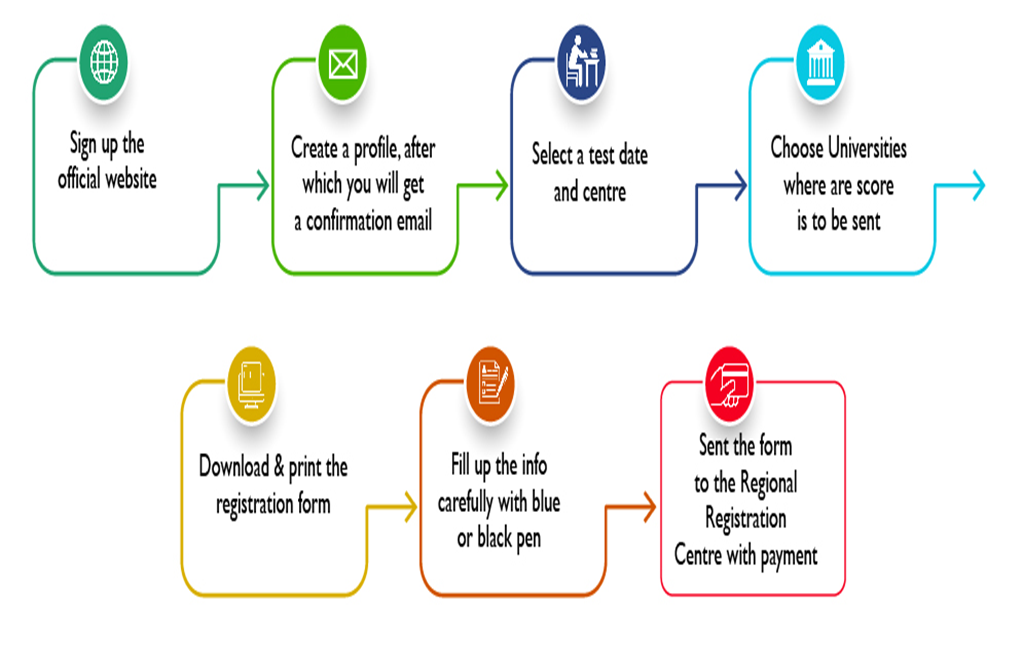
TOEFL Exam Registration Process –
Eligibility Criteria
TOEFL Exam Eligibility
The TOEFL exam has no specific minimum education or age eligibility requirements, though some universities recommend completing 10+2 and being at least 16 years old. To register, you must create an account on the ETS website , have a valid passport, and be prepared for potential system and environment requirements for the test format you choose.
General Eligibility
- Age Limit: The conducting body of the TOEFL test has not set any age limit. Therefore, anyone can sit for the exam. Especially, higher study aspirants planning to study abroad in an English-speaking country need to sit for the TOEFL exam as a part of the application or admission process.
- Education Qualifications: Although ETS has not set any academic qualification as a part of the TOEFL eligibility criteria, students who opt for the TOEFL exam should have passed 10+2 (Higher/Senior Secondary Level Exam) from a recognized board of education to be eligible to sit for the TOEFL exam
Exam Pattern
Reading: In this reading section, you will be required to read 3 to 5 passages, and answer 12 to 14 numbers of questions on each passage
Writing: In this writing section, your essay should effectively address the topic, and the response should be properly organised, as well as well-developed using relevant explanations and support. In addition to that, it should also display unity, coherence and progression.
Speaking: In this speaking section, your responses must fulfil the needs of the task given with only minor errors. This speaking test required highly intelligible as well as sustained conversation.
Listening: In this listening section, you are required to listen to short and long conversations. After hearing the short conversation, you will be asked one question and multiple choice answers will be given. You will have to choose the correct answer. Whereas, in the long conversation, you will be asked multiple questions based on the conversation.
| Sections/Subjects | Questions/Duration | Description |
|---|---|---|
| Reading | 3–4 passages - 10 questions each; Duration: 54-72 minutes | Candidates are required to read multiple passages and answer 30 - 40 questions. |
| Writing | 2 tasks; Duration: 50 minutes | Candidates are required to read a passage, listen to a recording, and type their response. |
| Speaking | 4 tasks; Duration: 17 minutes | Candidates are required to talk about a familiar topic and discuss material they have read and listened to. |
| Listening | 3-4 Lectures and 2-3 Conversations - 10 questions each; Duration: 41-57 minutes | Candidates are required to answer questions about brief lectures or classroom discussions. |
EXAM SYLLABUS –
| Section | Format | Number of Questions | Time Limit | Key Skills |
|---|---|---|---|---|
| Listening | Answer questions about classroom discussions or brief lectures | 28 | 36 minutes | Recognizing main ideas, understanding speaker attitudes, identifying connections between ideas |
| Reading | Read passages and respond to questions | 20 | 35 minutes | Identifying main ideas, understanding details, inferring, context vocabulary understanding |
| Speaking | Talk about a familiar topic and discuss material you read and heard | 4 tasks | 16 minutes | Delivering well-structured responses and integrating information from reading and listening tasks |
| Writing | Read a passage, listen to a recording, and enter your response. State and support a notion in an online classroom discussion | 2 tasks | 29 minutes | Synthesising information, developing arguments, maintaining coherence and clarity |
Result statistics
You will get four scaled section scores/results for TOEFL and a total score/consolidated score. Each section has a score range of 0–30. These are added together for a total score of 0–120.
| Skill | Level | Score Range |
|---|---|---|
| Reading | Advanced | 24–30 |
| Reading | High-Intermediate | 18–23 |
| Reading | Low-Intermediate | 4–17 |
| Reading | Below Low-Intermediate | 0–3 |
| Writing | Advanced | 24–30 |
| Writing | High-Intermediate | 17–23 |
| Writing | Low-Intermediate | 13–16 |
| Writing | Basic | 7–12 |
| Writing | Below Basic | 0–6 |
| Listening | Advanced | 22–30 |
| Listening | High-Intermediate | 17–21 |
| Listening | Low-Intermediate | 9–16 |
| Listening | Below Low-Intermediate | 0–8 |
| Speaking | Advanced | 25–30 |
| Speaking | High-Intermediate | 20–24 |
| Speaking | Low-Intermediate | 16–19 |
| Speaking | Basic | 10–15 |
| Speaking | Below Basic | 0–9 |